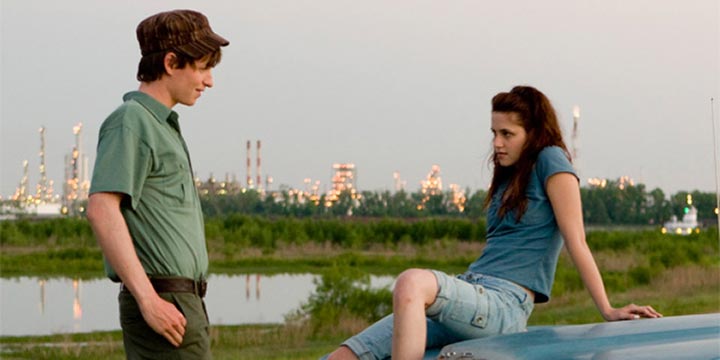
The Official Website for the 2008 Flm, The Yellow Hankerchief.
This was the official website for the 2008 film, The Yellow Hankerchief.
One lazy afternoon in a backwater Louisiana town, Martine takes a leap into an unfamiliar convertible. The driver, Gordy, an awkward young itinerant who eyed her in the diner earlier, isn’t displeased to find this pretty sylph in his front seat. Soon they meet Brett, a laconic, humble man just released from prison. Martine isn’t keen on going solo with Gordy, and now it’s raining cats and dogs, so she invites Brett along, and the unlikely trio sets out, each person unsure of the destination. What ensues is a journey through the lush green byways of rural Louisiana and into the depths of these characters’ souls.
Content is from the site's archived pages as well as from other outside sources.
The Yellow Handkerchief Official Trailer
A love story at its core, :"The Yellow Hankerchief" is about three strangers of two generations who embark on a road trip through post Katrina, La. Along the way, relationships forge and change in a myriad of ways, leading to the possibility of second chances at life and love. Brett Hanson dealing with a painful past, crosses paths with Martine, a troubled teenager, and her new 'ride' Gordy. The trio head out together, each motivated by his/her own reasons: Brett must decide whether he wants to return to the uncertainty of his life and his ex-wife May for whom he longs, Martine yearns to escape her family and Gordy hopes to get close to her.
Rating: PG-13 (for sexual content, some violence, language and thematic elements)
Genre: Drama, Romance
Directed By: Udayan Prasad
Written By: Erin Dignam
In Theaters: Feb 26, 2010 Wide
On Disc/Streaming: Jul 1, 2010
RottenTomatoes Tomatometer CRITICS 67% | AUDIENCE 59%
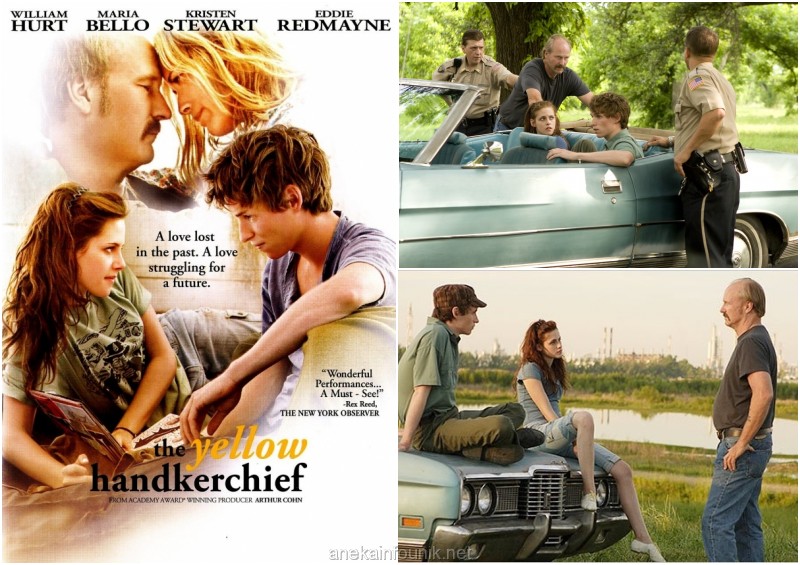
CRITICS REVIEWS
April 1, 2010 | Rating: 3/4
Joe Williams
St. Louis Post-Dispatch Top Critic
The unhurried direction of Udayan Prasad and the unafraid choices of the sure-footed cast keep this character-driven drama afloat.
+++
April 1, 2010 | Rating: 2/4
Connie Ogle
Miami Herald Top Critic
The only positive thing about the aimless film The Yellow Handkerchief is the idea that William Hurt may be ready for his Jeff Bridges moment.
+++
March 12, 2010 | Rating: 3/4
Colin Covert
Minneapolis Star Tribune Top Critic
Rating: PG-13 for sexual content, some violence, language.
This modest but moving indie ensemble piece puts three estimable actors in a convertible, sets them on a long drive to post-Katrina Louisiana and lets the character dynamics do the rest.
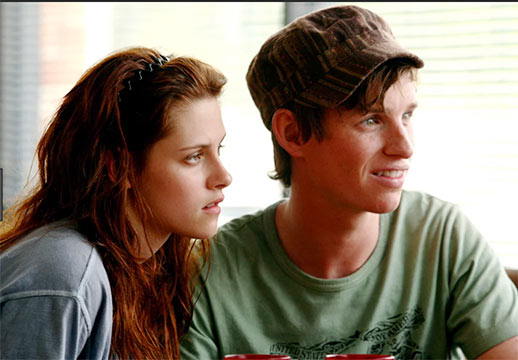
William Hurt brings a world of silent hurt to the role of an ex-con who picks up aimless, fidgety teen Kristen Stewart and her dorky would-be boyfriend, Eddie Redmayne. Their sentimental journey in Redmayne's ancient Ford LTD is fueled by Hurt's flashbacks of Maria Bello, the ex-lover who may or may not have something to do with his prison time. The three strangers open up to one another by degrees. The story meanders a bit as we puzzle over Hurt's motivation. Is he running away from something or toward something?
The healing family unit that evolves among the strangers is heartwarming, and the ravishing cinematography by Chris Menges ("The Mission") gives the southern locations a lush atmospheric beauty, whether they're stands of oaks or urban jungle. If "The Notebook" had you reaching for your handkerchief, this is your movie.
+++
October 14, 2010
Prairie Miller
Reelrave
Taking time off from vampire infatuation but still into Native male magnets, Kristen Stewart does a snobby sexpot, while the bayou weepie conjures a relentless alien place where crocodiles, snakes and eccentric when not unhinged redneck humans roam free
+++
May 15, 2010 | Rating: 3/4
Keith Cohen
Entertainment Spectrum
Three strangers form the bonds of a makeshift family as they take a road trip through the Louisiana bayous in an old convertible.
Brett Hanson (William Hurt from “Into the Wild” and “A History of Violence”) is a free man again after serving a six-year prison sentence for manslaughter. Martine (Kristen Stewart, best known as Bella Swan from the “The Twilight Saga” movies) is a troubled teenager who feels ignored by her truck driver father. Gordy (Eddie Redmayne from “The Other Boleyn Girl”) is a misunderstood youngster who grew up on an Indian reservation.
Their paths cross one lazy afternoon at a diner in a backwater town. They end up spending three memorable days together.
Brett is a man of few words, but he slowly reveals his painful past to the two kids. It involves his relationship with ex-wife May (Maria Bello from “A History of Violence,” “Thank You for Smoking” and “The Cooler”). His story is dramatized in flashbacks, which become the beating heart and motivational impetus of the movie.
This uplifting film is an indie gem with a wonderful payoff that will bring you to tears. The acting is superlative and makes this emotionally moving experience good to the last drop.
High praise goes to British director Udayan Prasad for using the eyes of the performers as windows to the soul. Screenwriter Erin Dignam has an astute understanding of the way men and women approach intimacy and love. Men are willing to jump right in before testing the water. Women want to get to know and feel comfortable around another person initially.
All the characters come from broken homes and are seeking a sense of belonging.
This film adaptation comes from a 1971 article written by Pete Hamill that inspired the Tony Orlando and Dawn hit song “Tie A Yellow Ribbon Round The Ole Oak Tree.”
Oscar-winning cinematographer Chris Menges (“The Reader,” “Michael Collins,” “The Mission” and “The Killing Fields”) wields a very observant camera that captures crucial non-verbal reactions.
Besides the lush green and swampy scenery of rural Louisiana, post-Katrina New Orleans and Morgan City background locations add immensely to the sentimental, thought-provoking atmosphere.
This slice-of-life romantic drama is now playing for a limited engagement exclusively at Screenland Crown Center.
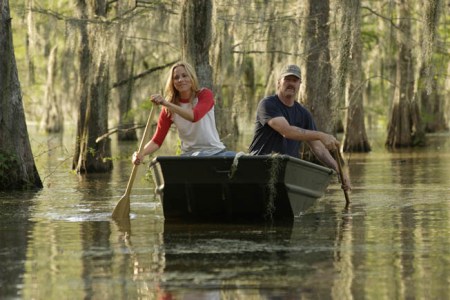
AUDIENCE REVIEWS
Lorin T April 7, 2010
***** So I was really looking forward to this movie when it was finally released in Austin . This little independent film was actually shot on location back in 2007 and is now just finding a very limited theater release thanks to Samuel Goldwyn distributors. The cast was impressive and the storyline was intriguing and naturally I found myself seeing this film in one of the few theaters in Austin on a recent trip.
The movie is actually a remake of a 1977 Japanese film. The story follows the lives of four unique characters who all feel out of place in their current situations and is set in present day Louisiana . Brett Hanson (William Hurt) has just been released from prison and finds himself suddenly on a road trip with Martine (Kristen Stewart) and Gordy (Eddie Redmayne) who also recently met. Hanson then retells the story of a lost love he once had with May (Maria Bello). The characters begin to find acceptance in each other and work to fill the voids each of them have in their own lives.
The story is deeply personal and really flows well with the interweaving plot lines. The characters are very real and believable and each comes with their own set of different flaws and weaknesses. The dialogue is very well written and again these characters are just believable. Itâ??s nice to see a love story about real people and not idealic perfect characters who participate in these grand love stories. This story is sweet and personal while at the same time it is truly believable. The characters are complex and develop on different levels. By the end of the movie, we really know what their weaknesses are and how they can use each other to fill their voids.
The movie was filmed beautifully and really emphasized the locations they shot at. There was some just amazingly beautiful locations in the movie. The lighting was soft and artistic and really gave a warm feel to this movie. There was a particular sequence of dialogue between Martine and Gordy which was filmed while they were driving down the highway in a convertible and the sound was just done so perfectly. I was amazed that they were able to get that sequence with doing the sound in post or having the wind drown out their words. The editing was also great and kept a nice pace to the movie and also switched between the past and present with ease.
The performances were superb and this is really what made the movie shine. All of the cast gave true heartfelt portrayals of these characters and you couldnâ??t help but just be drawn into the story through to the end. Kristen Stewart did a great job playing a fun lively character, which is a little different that the darker moodier characters most have seen her portray. It was refreshing to see her play an optimist and she gives the character a sort of wise innocence that I donâ??t think most other actresses her age couldâ??ve played. She also actually did a good job with the Southern accent. Most of the time, I cringe when actors try to pull of the Southern drawl in movies, but all the actors did really good with the subtle but believable accents. William Hurt and Maria Bello played really well off each other and had such great chemistry. Hurt proves why he is one of my favorite actors, you can just see the pain and regret in his face in this movie. Eddie Redmayne did fantastic. For a British actor to pull off this role, is no small feat. He plays the character so well that we truly are sympathetic for him but while still showing his uniqueness, quirks, and flaws.
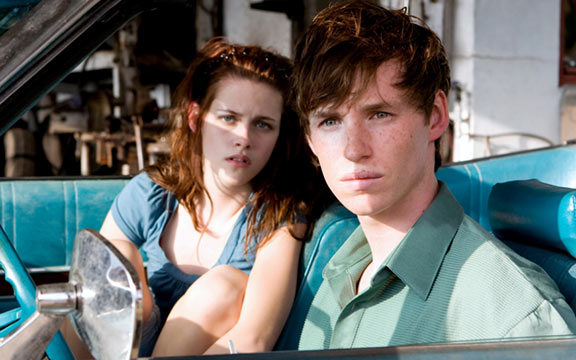
Overall, I was very happy with this movie. I wouldn’t necessarily label this a feel good movie, but rather a true life movie. These characters are believable and the story is captivating and mesmerizing. Itâ??s nothing spectacular or groundbreaking, its just so real and true that it shines brighter than others of this type. The producers said they had wanted to make a movie that was captivating without sex or violence and they really pulled it off. I usually prefer my movies to be rated â??Râ?? because that usually means they are more realistic however that is not the case here. I would recommend this to anyone who enjoys sweet personal dramas with strong lead actors. I can see your whole life in your face, and I love that face!
+++
***½ Sarah T March 23, 2010
william hurt was, well, william hurt. kristen stewart was okay, maria bello was great and and eddie redmayne was spectacular.
+++
***** Melissa M March 18, 2010
Beautifully nuanced film about loneliness and learning how to love other people well.
Matthew S ½March 13, 2010
Nice slice of life story about love and trust. I really enjoyed this film and the acting. A very believable and sweet story.
+++
***Josie-Lynn L March 6, 2010
I didn't know anything about this one before watching. Only that I don't enjoy Kristen Stewart very much... at all. But she did an OK job, and she wasn't as annoying as she usually is to me. William Hurt was really good. And the story was pretty good. Not the best, but pretty solid, I'd say. However, the relationship btwn K.Stewart and E.Redmayne was a little WTF....
+++
**½ John M March 3, 2010
"The Yellow Handkerchief", loosely based on a short story by writer Pete Hamill, is the story of three lost souls who happen upon each other one average Louisiana day. Starring William Hurt, Maria Bello, Kristen Stewart and Eddie RedMayne, the film starts out with, quite fittingly, yellow-washed credits.
The story centers around Brett Hanson (Hurt), a recent ex-convict, making his way back home. He meets Martine (Stewart) and Gordy (Redmayne) on a trip across the river. Through a stroke of bad (or good) luck, the three strangers are stranded together and slowly learn about each other's histories and how they ended up in the present day.
William Hurt plays Hanson with gusto. He's lost, hurt, hopeless and hopeful all at the same time. He plays both loner on a journey and father figure to two lonely teens. Despite his ex-convict status, one gets the impression Hanson is not a bad person. Throughout the film, as you learn his past, you understand where his emotions and state of mind come from.
Stewart's character, Martine, is also a lonely person. No caring family and no obvious friends, she takes the trip across the river in hopes of a quick joy ride allowing her to escape her desperate reality. Martine and her existence is believable, however Stewart still has some of her stereotyped panting and hair pulling which can sometimes make it hard to forget that you are watching Kristen Stewart. Forgetting these mannerisms, the part, including the southern accent, are well played.
Gordy, played by Eddie RedMayne, is an extremely awkward character to watch. I can't quite tell if the character is supposed to be that awkward of an individual or if RedMayne over-acted. Though he and Stewart's character are supposed to have chemistry on-screen, it's only when she dislikes him that their chemistry is believable.
Bello is seen through flash-backs and has little effect on the likeability of the film. She effectively plays a beautiful object of caring and desire, but she isn't given enough character depth and screen time to make an impact.
Unfortunately, I did not have much time to research this film before viewing. Upon leaving the theater, my impression was and still is that the acting by Hurt and Stewart was solid (and Redmayne if he was supposed to be that awkward), but there wasn't enough depth to the overall story line. I thought to myself (and out-loud), "this film felt like a short story more than a film". I am, therefore, not surprised to learn it's loosely based on a short story.
With a deeper story line, this film could have invested the audience more. As-is, there just isn't enough of a story to make a successful full-length feature film.
+++
Melinda S February 25, 2010
Love a good love story.
+++
***** paulinedao princesz A February 23, 2010
A love story at its core, THE YELLOW HANDKERCHIEF is about three strangers of two generations who embark on a road trip through post Katrina Louisiana.
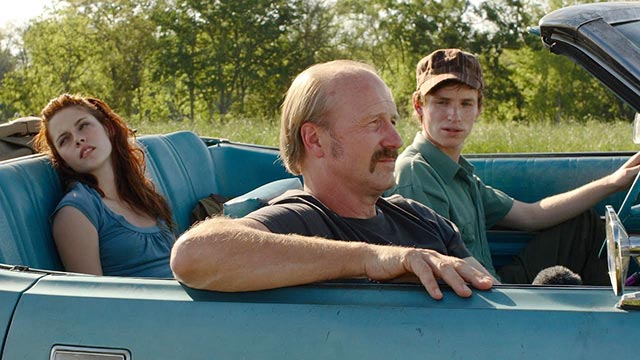
THE YELLOW HANDKERCHIEF
Roger Ebert
March 10, 2010 | www.rogerebert.com/
The action in "The Yellow Handkerchief" takes place within the characters, who don't much talk about it, so the faces of the actors replace dialogue. That's more interesting than movies that lay it all out. This is the story of three insecure drifters who improbably find themselves sharing a big convertible and driving to New Orleans not long after Hurricane Katrina.
The car's driver is a painfully insecure teenager named Gordy (Eddie Redmayne), who doubts most of what he does and seems to apologize just by standing there. At a rural convenience store, he encounters Martine (Kristen Stewart), running away from her life. He says he's driving to New Orleans. No reason. She decides to come along. No reason. They meet a quiet, reserved man named Brett (William Hurt), and she thinks he should come along. No particular reason.
We now have the makings of a classic road picture. Three outsiders, a fabled destination, Louisiana back roads and a big old convertible. It must be old because modern cars have no style; three strangers can't go On the Road in a Corolla. It must be a convertible because it makes it easier to light and see the characters and the landscape they pass through. They must be back roads because what kind of a movie is it when they drive at a steady 70 on the interstate?
The formula is obvious, but the story, curiously, turns out to be based on fact. It began as journalism by Pete Hamill, published in the early 1970s. In the movie's rendition, Brett fell in love with a woman named May (Maria Bello), then spent six years in prison for manslaughter charges, although his guilt is left in doubt. Martine slowly coaxes his story out of the secretive man.
You don't need an original story for a movie. You need original characters and living dialogue. "The Yellow Handkerchief," written by Erin Dignam, directed by Udayan Prasad, has those, and evocative performances. William Hurt occupies the silent center of the film. In many movies we interpret his reticence as masking intelligence. Here we realize it's a blank slate, and could be masking anything. Although his situation is an open temptation for an actor to signal his emotions, Hurt knows that the best movie emotions are intuited by the audience, not read from emotional billboards.
Stewart is, quite simply, a wonderful actress. I must not hold the "Twilight" movies against her. She played the idiotic fall-girl written for her, as well as that silly girl could be played, and now that "Twilight: New Moon" has passed the $300 million mark, she has her choice of screenplays for her next three films, as long as one of them is "The Twilight Saga: Eclipse." In recent film after film, she shows a sure hand and an intrinsic power. I last saw her in "Welcome to the Rileys," where she played a runaway working as a hooker in New Orleans. In both films she had many scenes with experienced older actors (Hurt, James Gandolfini). In both she was rock solid. Playing insecure and neurotic, yes, but rock solid.
The story of Redmayne, who plays Gordy, is unexpected. He fits effortlessly into the role of the scrawny, uncertain 15-year-old Louisiana kid. Yet I learn he is 27, a Brit who went to Eton, a veteran of Shakespeare and Edward Albee. Michael Caine explained to me long ago why it's easier for British actors to do American accents than the other way around. Whatever. You can't find a crack in his performance here.
These three embark on a road odyssey that feels like it takes longer than it might in real life. Their secrets are very slowly confided. They go through emotional relationships expected and not expected. They learn lessons about themselves, which is required in such films, but are so slowly and convincingly arrived at here that we forgive them. There is rarely a film where the characters are exactly the same at the end as they were at the beginning. (Note: Being triumphant is not a character change.)
Prasad made a wonderful British film in 1997, "My Son the Fanatic." I've seen none of his work since. Now comes this redneck slice of life. Since the characters are so far from the lives of the actors and the director, this is a creation of the imagination. As it must be. The ending is a shade melodramatic, but what the heck. In for one yellow handkerchief, in for a hundred.
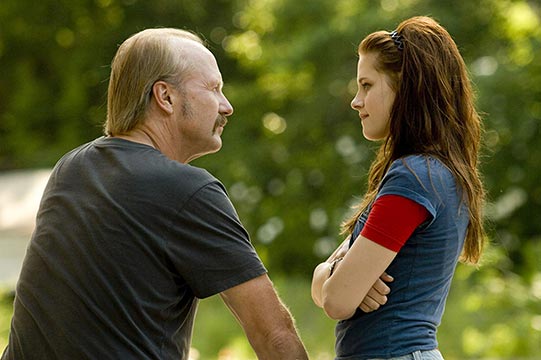
Review: 'The Yellow Handkerchief'
DEC 17, 2008 KEVIN THOMAS | http://www.latimes.com
Pete Hamill's Reader's Digest story "The Yellow Handkerchief" inspired Yôji Yamada's appealing 1977 film of the same name, and now it has become the basis for a new movie, also of the same name but not really a remake.
Screenplay writer Erin Dignam and director Udayan Prasad have taken the plot outline of the Yamada film and created original characters in a rural post-Katrina Louisiana, captured in evocative images by master cinematographer Chris Menges.
This "Yellow Handkerchief" is a gentle, low-key road movie, centering on the eternal need to love and to trust, suffused in the humanist spirit that has won its veteran producer, Arthur Cohn, three Oscars.
Cohn has assembled a quartet of gifted actors who are captivating under Prasad's perceptive direction. Eddie Redmayne's Gordy, a skinny, sweet-natured kid with wanderlust, passes through a tiny town in his vintage convertible and gives a lift to pretty teenager Martine ("Twilight's" Kristen Stewart), upset over an overly aggressive boyfriend and eager for a change of scenery, and to Brett (William Hurt), a middle-aged man of much kindness and concern for these two young people, but not eager to talk about himself.
We gradually learn Brett's story in flashbacks as he is swept over by memories of his passionate romance with the sensuous, earthy May (Maria Bello).
As Gordy heads toward New Orleans, we discover that his passengers -- as well as himself -- are longing for a connection with someone. As the three travelers affect each other, it becomes clear that, even though he's awkward with girls, Gordy is a resilient and resourceful kid, in some ways more mature than the seemingly poised Martine, who is well aware of her sexual appeal and who regards Gordy as a nerd.
Flashbacks of Brett's memories reveal that he and May are in deep need of each other, but issues of trust have May struggling.
"The Yellow Handkerchief" is adept at making a viewer care what happens to these very likable people.
More Background On TheYellowHandkerchief.com
TheYellowHandkerchief.com began as the official online home of The Yellow Handkerchief, an independently produced American drama directed by Udayan Prasad and built around an unusually distinguished ensemble cast. Although the movie premiered in 2008, its broader American theatrical release did not arrive until February 26, 2010. The website consequently occupies an interesting place in film and Internet history: it promoted a modest road movie featuring performers who were already respected or would soon become internationally famous, and it later survived in restored form after the film’s original promotional campaign had ended.
Today, the domain functions less like an active studio marketing site and more like a preserved digital exhibit. It introduces the film, embeds its trailer, summarizes its story and reproduces a substantial body of critical and audience commentary. That combination gives the website value beyond simple nostalgia. It allows visitors to see how an independent film was presented, discussed and positioned during the period when official movie websites were still important destinations in their own right.
The site is particularly useful for film students, admirers of the cast, researchers studying independent distribution and readers interested in Louisiana’s role as a motion-picture location. Its surviving content also documents the complicated reception of a film that some critics found moving and beautifully acted while others considered overly deliberate or sentimental.
What TheYellowHandkerchief.com Was Created to Promote
The original purpose of TheYellowHandkerchief.com was to support the release of The Yellow Handkerchief. The film follows three socially isolated people who form an improvised traveling group while crossing post-Hurricane Katrina Louisiana.
Brett Hanson, played by William Hurt, has just completed a six-year prison sentence. Quiet, emotionally guarded and uncertain about his future, he is attempting to decide whether he should return to May, the woman he loved before his incarceration. Martine, played by Kristen Stewart, is a restless teenager trying to escape a disappointing home life and an unhealthy encounter with a boy. Gordy, played by Eddie Redmayne, is an awkward young traveler who wants companionship and hopes to impress Martine.
Their journey unfolds in an aging convertible rather than a glamorous vehicle or carefully controlled setting. The car becomes a confined space in which the characters test one another, reveal fragments of their histories and gradually develop a temporary family-like bond.
The film alternates between the road trip and memories of Brett’s relationship with May, portrayed by Maria Bello. Those flashbacks explain his imprisonment, his guilt and the meaning of the yellow handkerchiefs that ultimately become the story’s central symbol.
The official website’s basic informational role was therefore straightforward. It gave prospective viewers the premise, trailer, cast information, rating, genre and release details needed to understand the film. More importantly, it presented the movie as an intimate story about reconciliation, loneliness, trust and second chances rather than as a conventional crime drama about a recently released prisoner.
Ownership, Production and Distribution
The film was produced by Arthur Cohn, whose career made the project more prestigious than its limited theatrical profile might initially suggest. Cohn has been associated with internationally recognized films including The Garden of the Finzi-Continis, Central Station, One Day in September and The Chorus. His work has frequently crossed national and linguistic boundaries, making the American adaptation of a celebrated Japanese story consistent with his broader career.
Cohn obtained remake rights from the Japanese studio Shochiku in the early 2000s. The screenplay was written by Erin Dignam, and Udayan Prasad was selected to direct. Prasad was already respected for human-centered dramatic work such as My Son the Fanatic. His restrained approach suited a story in which emotional meaning often appears through silence, facial expression and physical distance rather than explanatory dialogue.
Arthur Cohn Productions was the principal production company, while Samuel Goldwyn Films acquired American distribution rights after the movie had already premiered and completed an awards-qualifying engagement. Contemporary listings consistently identified TheYellowHandkerchief.com as the official site connected with the Samuel Goldwyn release.
The website should therefore be understood primarily as a film-marketing property rather than an independent publication. Its original ownership and operational arrangements are not clearly disclosed in the surviving public-facing material. However, its branding, release information and industry listings demonstrate that it served the production and distribution campaign.
Website Design, Content and Navigation
The restored site is relatively compact. It does not attempt to reproduce every interactive feature that may have existed during the theatrical campaign. Instead, it operates as a long-form film information page.
Its main content areas include:
The movie’s official trailer; a synopsis of the Louisiana road trip; the principal cast and creative credits; the Motion Picture Association rating; theatrical and home-entertainment information; critical reviews; audience reactions; and longer reviews originally published by prominent media outlets.
Rather than dividing the information into an elaborate modern menu, the current version encourages visitors to scroll through a continuous collection of material. This presentation resembles an online clipping file or course reader more than a contemporary entertainment website.
That simplicity has advantages. Readers can move directly from the story description to critical responses without navigating advertising-heavy databases or opening numerous separate pages. The disadvantage is that some reproduced information reflects the time at which it was collected. Ratings, streaming availability and audience scores can change, so the restored site is best treated as a historical resource rather than a continuously updated film database.
The text also contains occasional spelling, formatting and encoding irregularities. These do not erase its archival value, but they reinforce the impression that the site preserves material accumulated from older web pages and outside sources rather than presenting a newly edited commercial release campaign.
The Film’s Origins in American and Japanese Popular Culture
The history behind The Yellow Handkerchief extends considerably further back than the American film or its website.
The narrative is commonly associated with a brief story by journalist and novelist Pete Hamill. In its familiar form, the story concerns a man returning home after imprisonment who asks the woman he loves to display a yellow cloth if she still wants him. As his bus approaches the place where the signal should appear, he is too frightened to look. Other passengers watch for him and discover not one small sign but a dramatic display of yellow cloths.
Versions of the story circulated widely and became connected to the 1973 popular song “Tie a Yellow Ribbon Round the Ole Oak Tree,” recorded by Tony Orlando and Dawn. The yellow ribbon subsequently developed a broader cultural meaning as a symbol of welcome, remembrance and hopeful return.
Japanese filmmaker Yōji Yamada transformed the underlying idea into the 1977 film The Yellow Handkerchief of Happiness. That movie became a major Japanese success and won extensive recognition at the first Japan Academy Film Prize ceremony. Its honors included awards connected with best picture, director, screenplay and acting.
The 2008 American production is therefore neither a literal filming of the short anecdote nor simply a direct translation of the Japanese movie. It relocates the emotional framework to Louisiana, introduces specifically American social backgrounds and uses the aftermath of Hurricane Katrina as an environmental and cultural setting.
TheYellowHandkerchief.com helps preserve the final American stage of this international chain: an urban American story became part of popular music culture, inspired a celebrated Japanese film and was then reimagined as an American independent production.
Production in Louisiana
Principal photography took place in Louisiana in 2007. Reported locations included New Orleans, Morgan City, Berwick, Abita Springs and Chalmette. The use of genuine Louisiana settings is one of the film’s most frequently praised qualities.
Morgan City and the surrounding Cajun Coast have a long association with film production. The regional film trail continues to identify The Yellow Handkerchief among the movies that used its homes, streets, docks, waterways and surrounding landscape. Berwick’s downtown and waterfront areas provided the kind of weathered, visually specific environment essential to the film’s mood.
These locations are not merely decorative. The travelers pass storm-damaged structures, industrial areas, open roads, marshland, small towns and landscapes marked by water. The post-Katrina environment reflects the emotional condition of the characters: damaged but functioning, uncertain yet persistent.
The film’s proximity to New Orleans gives the destination symbolic importance. New Orleans represents both return and possibility, but the journey through less familiar Louisiana communities matters just as much as the eventual arrival. The movie deliberately avoids reducing the state to French Quarter imagery or tourist landmarks. Instead, it concentrates on ordinary roads, working communities, isolated buildings and the visual transition between rural and urban Louisiana.
Cinematographer Chris Menges played a major role in creating this atmosphere. Menges had already won Academy Awards for The Killing Fields and The Mission. His photography gives the landscape a warm, humid and sometimes melancholy quality. Critics who were unconvinced by the screenplay frequently still praised the visual treatment of the bayous, roads and post-storm surroundings.
William Hurt’s Preparation and the Film’s Acting Style
William Hurt’s performance is the film’s emotional center. Brett is not written as an energetic or verbally demonstrative character. His inner life must be inferred from pauses, posture, guarded reactions and the gradual release of information.
To prepare, Hurt spent several days at Louisiana State Penitentiary, commonly known as Angola. He stayed overnight in a maximum-security cell and spoke with incarcerated men about their experiences. During a 2010 interview with Terry Gross, he described the physical severity of the cell and explained that he had spent four days on the prison grounds asking inmates about their lives and states of mind.
This research did not produce a stereotypically hardened ex-convict. Instead, Hurt portrays Brett as a man disoriented by freedom, deeply ashamed of his past and frightened by the possibility that May has stopped waiting for him.
Kristen Stewart’s Martine brings a different form of insecurity. The character can be lively, provocative, defensive and vulnerable within a short period. The film was made before Stewart’s fame from the Twilight series reached its peak, although its eventual American release allowed distributors and journalists to emphasize her involvement.
Eddie Redmayne’s Gordy is one of the actor’s notable early American roles. Redmayne, an English performer with extensive theater training, plays a socially clumsy young man from a Native American background. Contemporary reviewers disagreed about whether Gordy’s extreme awkwardness was endearing or distracting, but many recognized the technical accomplishment of Redmayne’s accent and physical characterization.
Maria Bello appears largely in Brett’s memories, yet May is essential to the story. She is not simply a prize awaiting his return. The flashbacks reveal a relationship shaped by desire, affection, mistrust, anger and consequences. Whether she will welcome Brett cannot be taken for granted, which gives the yellow-handkerchief signal its emotional force.
Sundance Premiere, Release Delays and Popularity
The Yellow Handkerchief premiered at the Sundance Film Festival in January 2008 in the Premieres program. Sundance provided significant exposure and photographs from the event show members of the cast and production team attending the Eccles Theatre premiere.
Despite that visibility, the film did not move immediately into a substantial theatrical release. It received a short awards-qualifying engagement late in 2008 and remained without broad American distribution for an extended period. Samuel Goldwyn Films announced its acquisition of American rights in May 2009, and the limited commercial release followed on February 26, 2010.
The gap between production, festival premiere and theatrical availability complicated the marketing campaign. By 2010, Stewart’s Twilight fame had become a major promotional asset, while Redmayne was still years away from the Academy Award and international recognition he would receive for The Theory of Everything.
The film remained a specialty release. Public box-office databases place its American theatrical gross at slightly more than $300,000, with its widest release limited to only a few dozen theaters. Those figures indicate modest theatrical popularity rather than mainstream commercial success.
Its limited earnings should not be interpreted as proof that the movie had no audience. Independent dramas with restrained pacing, adult emotional themes and small release footprints frequently rely on festivals, reviews, home video, television and later streaming discovery. The cast’s increasing fame gave The Yellow Handkerchief a longer afterlife than its initial box office might suggest.
For many later viewers, it became an opportunity to see Stewart and Redmayne at earlier stages of their careers alongside established performers Hurt and Bello.
Awards and Recognition
The American film did not reproduce the extraordinary awards success of Yōji Yamada’s Japanese version. Its most important institutional recognition came through selection for the 2008 Sundance Film Festival.
The production nevertheless carried substantial award-winning credentials. Arthur Cohn had produced multiple Academy Award-winning films. Chris Menges was a two-time Academy Award-winning cinematographer. William Hurt had won the Academy Award for Kiss of the Spider Woman and received several additional nominations. The presence of such established talent gave the film artistic stature even without a major awards campaign of its own.
Festival organizations also treated it as more than a celebrity vehicle. The San Francisco International Film Festival described it as a story of first love and second chances and emphasized the work of Cohn, Menges and Prasad. This framing aligns with the movie’s intended identity as a humanist ensemble drama.
Critical Reviews
Critical reception was mixed but generally respectable. Rotten Tomatoes’ current consensus characterizes the film as small and intimate, sometimes excessively so, while crediting the performances of William Hurt and Kristen Stewart with elevating familiar material.
Roger Ebert responded positively to the movie’s quietness. He emphasized that much of its action occurs within the characters and praised the way the actors’ faces carry meaning that other films might state through dialogue. Ebert regarded Hurt as the silent center of the story and also praised Stewart and Redmayne.
Kevin Thomas of the Los Angeles Times called the picture gentle and low-key. He noted that Prasad and screenwriter Erin Dignam used the Japanese film’s basic outline while creating original characters suited to rural, post-Katrina Louisiana. Thomas also highlighted the humanist tradition associated with Arthur Cohn’s producing career.
Other reviewers were less persuaded. Common criticisms included slow pacing, predictable sentiment, an overly familiar road-movie structure and insufficient narrative depth. Some thought the young characters were irritating or that the romantic resolution was too calculated.
Even among negative or mixed assessments, however, several points of agreement emerged. Hurt’s restrained performance was widely respected, the cast was considered unusually strong for such a modest film and Menges’ Louisiana photography was repeatedly praised.
This divided response is reflected on the restored website, which does not present only favorable publicity. By preserving enthusiastic, lukewarm and openly negative opinions, the site provides a more revealing record of the film’s reception than a conventional promotional page would normally offer.
Audience Reviews and Long-Term Reputation
Audience responses have followed a similar pattern. Admirers describe the movie as nuanced, believable and emotionally generous. They appreciate that its characters are flawed and that their relationships develop gradually rather than through spectacular plot twists.
Some viewers particularly value the film’s treatment of loneliness. Brett, Martine and Gordy are separated by age and experience, but each is looking for acceptance. Their temporary community makes the road trip feel less like transportation and more like a test of whether damaged people can trust one another.
Detractors describe the film as predictable, excessively sentimental or too slight for its running time. Gordy’s behavior and the uneven chemistry between the younger characters are recurring sources of criticism.
Later reviews reveal that the film continues to be discovered long after its theatrical run. Streaming, home video, cast retrospectives and recommendation platforms have kept it accessible. It is now frequently discussed as a small, sincere drama rather than as a major release from 2010.
The presence of Hurt, Stewart, Bello and Redmayne also creates multiple entry points for new audiences. A viewer may arrive because of interest in Redmayne’s early career, Stewart’s work outside major franchises, Hurt’s later performances or Bello’s dramatic roles.
Intended Audience and Educational Value
The site’s most natural audience includes fans of the actors, students of independent cinema, admirers of road movies and people interested in Louisiana film production. The PG-13 rating makes the movie accessible to older teenagers, although its themes of incarceration, sexuality, grief, violence and relationship instability give it a distinctly adult emotional perspective.
The restored website says it has been preserved as required reading for a university-level American film course. Publicly accessible evidence confirming the described course, professor and enrollment details is limited, so those statements should be regarded as part of the restored site’s own account rather than independently verified institutional information.
Even so, the domain genuinely has educational uses. It can support discussion of adaptation, independent distribution, online film promotion, star marketing and the preservation of commercial websites. It also offers a compact case study in how reviews from different outlets can frame the same performance or directorial decision in sharply different ways.
Students can compare the Pete Hamill narrative, the Japanese adaptation and the Louisiana version. They can examine why the same ending might appear emotionally satisfying to one critic and manipulative to another. They can also explore how Katrina-era imagery shapes a story that did not originally belong to Louisiana.
Cultural and Social Significance
The film’s most enduring cultural theme is the possibility of return. Brett is not merely traveling back to a geographic location. He is testing whether a former life, damaged relationship and lost sense of belonging can still be recovered.
The yellow handkerchiefs externalize that uncertainty. Instead of requiring May to deliver a speech, the story allows a visual signal to answer Brett’s deepest question. The symbol works because it combines public display with private meaning.
The post-Katrina setting adds another dimension. Louisiana itself is portrayed as wounded but not emptied of life. Communities continue operating amid damaged structures and altered landscapes. The environment does not function as a documentary record of the disaster, but it creates a parallel between regional recovery and individual recovery.
The film also treats social isolation across generations. Brett has been physically removed from society by imprisonment. Martine feels neglected and undervalued. Gordy is socially inexperienced and desperate for connection. Their circumstances differ, but all three are struggling with the fear that other people will reject them once they are fully known.
The story’s continuing relevance comes from that theme. The movie asks whether people should be defined by their worst decisions, whether affection can survive long separation and whether strangers can temporarily give one another the courage to go home.
The Importance of Preserving the Website
Official film websites are often designed for short commercial lives. Domains expire, distributors reorganize, multimedia files stop working and pages disappear when a release campaign ends. As a result, researchers may find extensive information about a film on modern databases while losing the promotional environment through which the film originally addressed its audience.
TheYellowHandkerchief.com illustrates both the fragility and usefulness of such sites. Its restored version does not perfectly recreate every feature of the original campaign, and some of its editorial assertions cannot be independently confirmed. Nevertheless, it preserves the domain, the film’s promotional identity, its trailer and a large collection of period reactions.
That preservation matters because a film’s official site is itself a historical artifact. It reveals which performers were emphasized, how the story was summarized, what genre labels were applied and which reviews were considered important enough to reproduce.
The current domain is therefore more than a page about an older movie. It is an example of how commercial web properties can become informal archives after their original economic purpose disappears.
Overall Assessment
TheYellowHandkerchief.com introduces visitors to a modest but unusually well-credentialed independent film. Its subject is a Louisiana road trip, but its deeper concerns are shame, trust, emotional risk and the possibility of being welcomed home.
The website’s strongest qualities are the amount of surviving review material, its straightforward presentation of the film’s premise and its preservation of the official domain associated with the theatrical campaign. It is especially useful for readers who want more than a cast list but do not need the commercial complexity of a current studio site.
Its limitations should also be understood. The restored page mixes archived material, external commentary and newer editorial framing. Some claims about the restoration and academic use are self-reported, and several statistics reflect older snapshots rather than continuously updated data.
Despite those qualifications, the site provides a meaningful entry point into the film. It connects the Louisiana production with its Japanese predecessor, documents the critical disagreement surrounding the release and highlights early work by performers whose careers later became even more prominent.
For contemporary visitors, TheYellowHandkerchief.com is best approached as both a film guide and a piece of digital history: the surviving online home of a quiet drama whose theatrical footprint was small, but whose themes, performances and yellow symbol have continued to attract viewers years after its original journey ended.